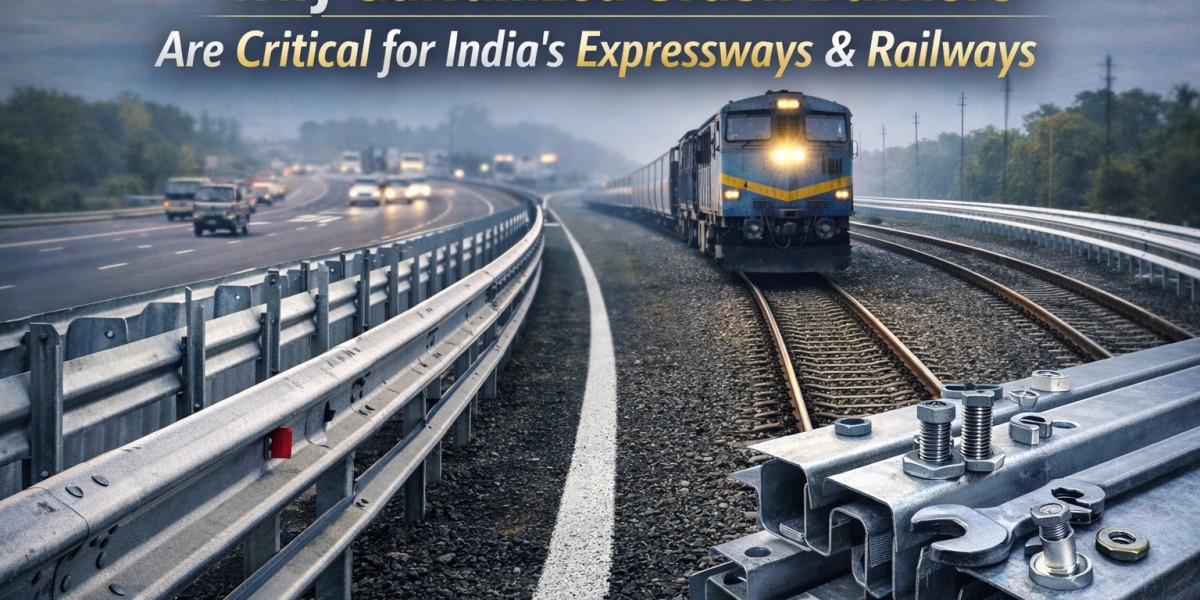
India is rapidly expanding its highway and railway infrastructure. With projects like the National Highways Authority of India accelerating expressway construction and the Indian Railways modernizing rail corridors, safety systems have become more important than ever.
According to the Ministry of Road Transport & Highways, India reports over 4.5 lakh road accidents annually. A significant percentage of fatal injuries occur due to vehicles veering off highways or colliding with roadside obstacles. This is where Galvanized Crash Barriers play a life-saving role.
As experienced Galvanized Crash Barrier Manufacturers in India, we’ve seen how properly engineered barriers reduce impact severity, prevent cross-over crashes, and protect critical railway infrastructure. In this guide, we explain why galvanized barriers are not just optional infrastructure—but essential safety investments.
Product Overview & Standout Features
What is a Galvanized Crash Barrier?
A Galvanized Crash Barrier is a steel safety system coated with zinc through hot-dip galvanization to prevent corrosion. It is commonly installed along highways, expressways, bridges, medians, and railway zones.
Why Galvanization Matters
Hot-dip galvanizing creates a protective zinc layer that:
- Prevents rust and corrosion
- Extends service life up to 20–25 years
- Reduces maintenance costs
- Withstands extreme Indian weather conditions
Applications
1️⃣ Expressways
India’s high-speed corridors require durable median and roadside protection. Leading Expressway Crash Barriers Manufacturers in India design systems that absorb and redirect vehicle impact energy.
2️⃣ Railways
A Railway Crash Barrier protects tracks, signaling equipment, and nearby infrastructure from vehicular intrusion at crossings, bridges, and elevated corridors.
Technical Specifications
High-quality galvanized crash barriers typically meet IRC and MORTH standards.
Standard Specifications
- Material: High tensile steel
- Coating: Hot-dip galvanized (610–1100 GSM zinc coating)
- Thickness: 2.5 mm – 3.15 mm
- Impact Resistance: Designed for high-speed collision absorption
- Design Types: W-Beam, Thrie-Beam, Double-sided barriers
- Compliance: IRC:SP:84, MORTH Section 800
Structural Performance
- Energy absorption capacity to reduce impact force
- Controlled vehicle redirection
- Prevention of vehicle rollover
- Protection against cross-median collisions
As one of the trusted Galvanized Crash Barrier Manufacturers in India, quality compliance is non-negotiable—each batch undergoes tensile strength and coating thickness testing.
Pros & Cons
Advantages of Galvanized Crash Barriers
✔ Long-lasting corrosion resistance
✔ Ideal for coastal and high-humidity regions
✔ High impact energy absorption
✔ Low lifecycle maintenance cost
✔ IRC & MORTH compliant
✔ Suitable for highways and railway safety
Limitations
✘ Higher initial investment compared to painted barriers
✘ Requires professional installation
✘ Heavy material handling during transport
However, when evaluated over a 20-year lifecycle, galvanized systems prove significantly more cost-effective.
Comparison to Alternatives
Galvanized vs Non-Galvanized Barriers
Feature | Galvanized Barrier | Painted Barrier |
Corrosion Resistance | Excellent | Moderate |
Lifespan | 20–25 Years | 5–8 Years |
Maintenance | Minimal | Frequent repainting |
Cost Efficiency | High (Long Term) | Lower (Short Term) |
Why Galvanized Wins in Indian Conditions
India’s climate ranges from coastal humidity to desert heat. Non-galvanized steel corrodes quickly, especially in states like Maharashtra, Tamil Nadu, and Gujarat.
For railway applications, corrosion resistance is even more critical due to vibration and environmental exposure. A Railway Crash Barrier must remain structurally intact under continuous stress.
Real-World Scenario
On newly constructed expressways, improperly protected steel barriers have shown visible rust within 3–5 years. In contrast, hot-dip galvanized crash barriers maintain structural integrity for over two decades.
This is why major infrastructure projects increasingly rely on Expressway Crash Barriers Manufacturers in India that provide certified galvanized systems.
Conclusion
India’s expanding expressway and railway network demands infrastructure that prioritizes safety, durability, and compliance.
Why Galvanized Crash Barriers Are Critical:
- They save lives by reducing accident severity
- They protect railway and roadside assets
- They withstand extreme Indian weather
- They reduce long-term maintenance costs
- They meet national safety standards
While the initial investment may be higher, the long-term safety and cost benefits far outweigh the expense.
At Tread Safe Steel, we specialize in manufacturing high-performance Galvanized Crash Barriers engineered to meet Indian infrastructure demands. With strict quality control, IRC compliance, and precision galvanization, we deliver solutions trusted across highways and railways.
FAQ
1. What is the lifespan of a galvanized crash barrier?
Typically 20–25 years, depending on environmental exposure and maintenance.
2. Why is galvanization important for crash barriers?
It protects steel from corrosion, significantly extending durability and structural integrity.
3. Are galvanized crash barriers mandatory for expressways?
Most expressway projects in India require IRC and MORTH-compliant galvanized barriers for safety and durability.
4. What is the difference between railway and highway crash barriers?
Railway crash barriers are designed to protect tracks and equipment, while highway barriers focus on vehicle redirection and impact absorption.
5. Who are trusted Galvanized Crash Barrier Manufacturers in India?
Companies like Tread Safe Steel provide high-quality, compliant crash barrier systems for highways and railways across India.