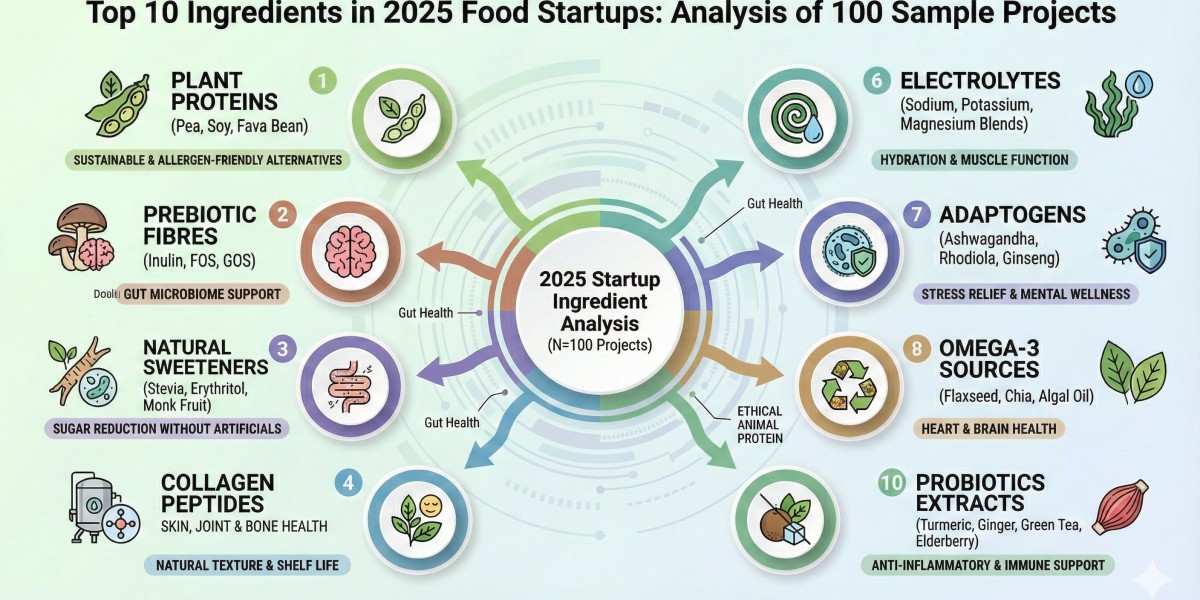
The food & nutraceutical ecosystem continues to evolve rapidly, driven by consumer health trends, clean-label expectations, and the growth of functional ingredients.
Based on an internal review of 100 sample food and beverage development projects, here are the top 10 most frequently used ingredients in food startups during 2025.
This analysis helps founders, R&D teams, and product innovators understand where the market is heading and which ingredients dominate early-stage formulation.
1. Plant Proteins (Pea, Soy, Fava Bean)
Plant-based products continue to stay strong in 2025.
Pea protein remains the most popular because of its neutral taste, solubility, and allergen-free profile.
Why startups love it: clean-label, high nutritional value, easy to formulate.
2. Prebiotic Fibres (Inulin, FOS, GOS)
Digestive health products and functional beverages often rely on fibre enrichment.
Key advantage: doubling market interest due to gut-health awareness.
3. Natural Sweeteners (Stevia, Erythritol, Monk Fruit)
Sugar reduction is a priority for nearly all new brands.
Trend: Startups prefer natural sweeteners over artificial ones for clean-label positioning.
4. Collagen Peptides
Beauty-from-within and anti-aging categories are booming.
Forms used: Type I & III collagen in beverages, bars, and gummies.
5. Clean-Label Stabilizers (Pectin, Agar, Guar Gum)
Startups aim to avoid synthetic stabilizers, so natural hydrocolloids are trending.
Usage: beverages, spreads, plant-based dairy, gummies.
6. Electrolytes (Sodium, Potassium, Magnesium Blends)
Hydration and energy drinks dominate startup categories in 2025.
Observation: Magnesium-based blends are gaining popularity for wellness claims.
7. Adaptogens (Ashwagandha, Rhodiola, Ginseng)
Mental wellness + stress management = massive trend.
Startups use low dosages to ensure stability in RTD beverages and gummies.
8. Omega-3 Sources (Flaxseed, Chia, Algal Oil)
Algal oil continues to replace fish oil because it’s vegan and eco-friendly.
9. Probiotics (Lactobacillus & Bifidobacterium Strains)
The probiotic-based functional food category grew significantly in 2025.
Challenge: ensuring viability during processing — something we handle often in R&D projects.
10. Botanical Extracts (Turmeric, Ginger, Green Tea, Elderberry)
Botanicals remain popular for immune support and clean-label claims.
Formats: powders, extracts, microencapsulated blends.
Key Insights from the 100 Project Analysis
- 72% of startups focused on health-forward products
- 48% prioritized clean-label & natural ingredients
- 36% incorporated functional active ingredients
- 29% attempted to create low- or zero-sugar formulations
- 22% targeted gut-health as their primary claim
The shift toward science-backed, functional ingredients is stronger in 2025 than ever before.
Need Help Formulating or Selecting Ingredients?
If you’re building a new food, beverage, or nutraceutical product, our R&D team can support you with:
- Ingredient selection & supplier guidance
- Prototype development
- Nutraceutical formulation
- Stability, shelf-life & sensory testing
- Compliance & label development
Learn more at: https://www.foodresearchlab.com/
Looking to Develop Your Own Product?
We assist startups, brands, and manufacturers across the globe in formulating successful, market-ready food and nutraceutical products.
Explore our services:
https://www.foodresearchlab.com/services/food-product-development/