SaaS companies entering 2026 face an undeniable challenge. Growth is accelerating, but human teams alone struggle to keep pace. Development cycles stretch longer, support queues expand, and compliance reviews consume valuable weeks.
This is where Agentic AI Co-Workers change the equation. These intelligent systems function as digital teammates that handle routine operations, reason through structured workflows, and escalate only complex decisions to humans.
What Is an Agentic AI Co-Worker?
An Agentic AI Co-Worker is designed to function like a proactive team member. It breaks down tasks into structured steps, uses internal documentation and connected tools, and executes actions independently.
Unlike traditional chatbots that generate isolated responses, these systems retain context across workflows and perform operational actions such as updating records, triggering deployments, or sending notifications.
They integrate seamlessly across departments:
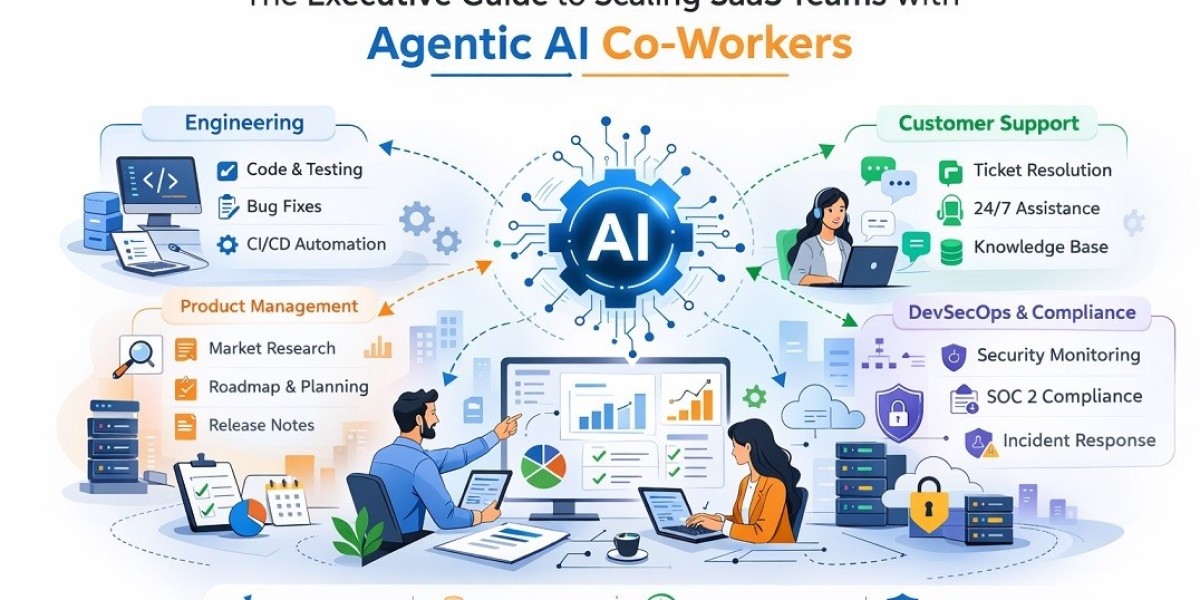
- Engineering agents draft specs, write tests, and resolve minor bugs.
- Product agents summarize feedback and generate release documentation.
- Compliance agents compile SOC 2 reports.
- Support agents resolve repetitive tickets autonomously.
These systems operate continuously, allowing teams to focus on high-impact decisions.
The Four SaaS Teams That Benefit Most
Engineering Teams
Developers spend significant time on repetitive implementation tasks. AI Co-Workers accelerate progress by generating starter code, writing unit tests, identifying performance issues, and assisting in migration scripts.
Sprint velocity improves as engineers shift from boilerplate tasks to strategic innovation.
Product Management Teams
Product managers often manage documentation and research overhead. AI Co-Workers streamline operations by summarizing user insights, drafting PRDs, comparing competitors, and preparing release notes.
This allows product leaders to focus on prioritization and strategic roadmap decisions.
Customer Support Teams
Support teams frequently manage high volumes of Level 1 and Level 2 queries. AI Co-Workers resolve routine tickets such as password resets or onboarding questions. They escalate complex cases with full contextual history.
The result is lower cost per ticket and improved customer satisfaction.
DevSecOps Teams
Security and operations teams oversee compliance and system integrity. AI Co-Workers monitor CI/CD pipelines, scan for vulnerabilities, validate compliance controls, and analyze logs for anomalies.
Continuous monitoring ensures faster detection and reduced deployment risk.
Build vs Buy: Executive Decision Guide
Executives must determine whether to build custom AI systems or adopt ready-made solutions.
Build Custom When:
- Workflows are proprietary
- Engineering tasks require deep customization
- AI differentiates your product
Buy Ready-Made When:
- Tasks are standardized
- Support ticket automation is needed
- Compliance workflows follow common frameworks
Organizations adopting structured agentic AI development for SaaS gain flexibility while maintaining scalability.
90-Day Deployment Roadmap
Phase 1 – Assessment (Weeks 1–3)
Audit workflows, identify operational bottlenecks, and prioritize 3–5 high-impact use cases.
Phase 2 – Build & Integration (Weeks 4–8)
Develop multi-agent architectures and integrate with existing systems such as GitHub, Zendesk, or internal APIs.
Phase 3 – Scale (Weeks 9–12)
Expand deployment across teams, introduce feedback loops, and track KPIs to measure impact.
Risk Mitigation Strategies
Autonomy should not eliminate oversight. Implement human-in-the-loop approvals for high-risk decisions. Maintain role-based access controls and comprehensive audit logs.
Reduce hallucination risk using retrieval-based grounding, strict policy constraints, and layered validation mechanisms.
Proper onboarding ensures internal teams understand the value and adopt AI Co-Workers confidently.
Why Invimatic
Invimatic helps SaaS companies deploy production-ready Agentic AI Co-Workers that accelerate development cycles, reduce operational costs, and support teams continuously.
Our architects design engineering agents, compliance agents, support agents, and multi-agent systems tailored to each organization’s workflows using a structured 90-day framework.