Forging shapes metal through compressive forces from hammers, presses, or dies typically after heating for malleability yielding stronger components with refined grain structures versus casting or machining.
Forging Market Overview
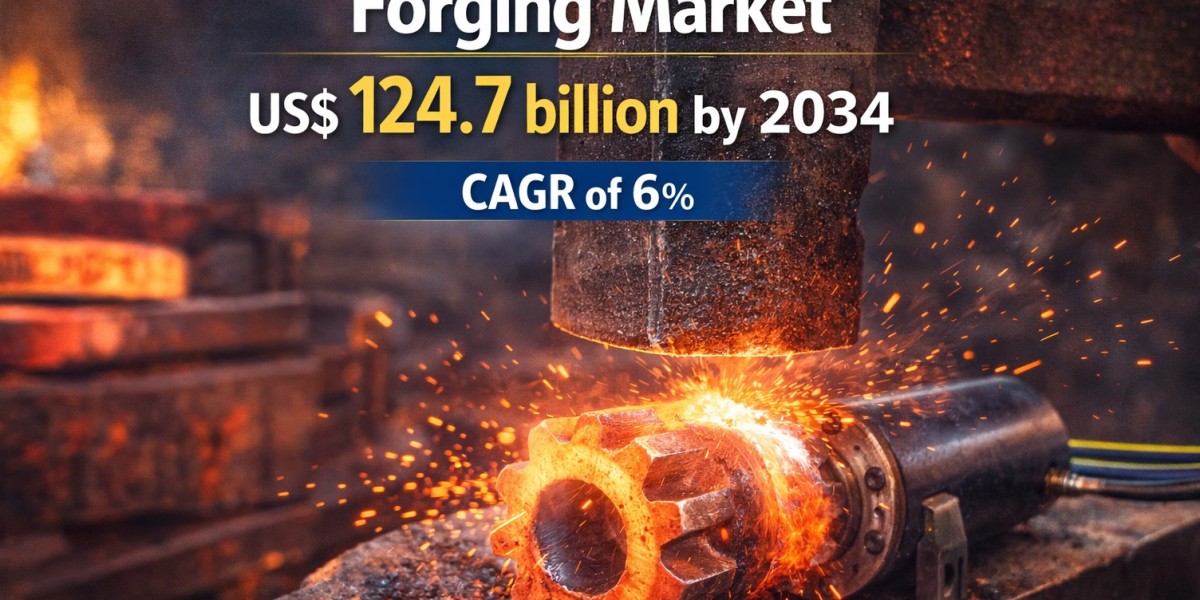
According to the latest assessment by The Insight Partners, the Forging Market is projected to grow from US$ 78.1 billion in 2023 to US$ 124.7 billion by 2031, registering a CAGR of 6% during the forecast period. Growth is primarily fueled by increased investments in renewable energy infrastructure, rising aircraft production, expansion of automotive manufacturing, and large-scale industrialization in emerging economies.
The global forging market is witnessing steady expansion, driven by rising demand from automotive, aerospace, construction, railway, and renewable energy industries. Forging is a critical metal-forming process that produces components with superior strength, durability, and fatigue resistance compared to cast or machined alternatives. These properties make forged components essential in safety-critical and high-performance applications such as crankshafts, connecting rods, turbine shafts, flanges, valves, and structural components.
Key Market Drivers: Automotive and Renewable Energy Demand
One of the key drivers of the forging market is the growing use of forged steel in the automotive sector. Forged steel components offer high strength-to-weight ratios, excellent impact resistance, and long service life, making them suitable for critical parts such as crankshafts, control arms, camshafts, steering knuckles, and connecting rods. Closed-die forging enables near-net shape production, reducing machining time and material waste. The rapid growth of electric vehicles (EVs) is further boosting demand for lightweight and precision-forged steel and aluminum components.
The global push toward renewable energy generation, particularly wind power, is also accelerating demand for forged components. Wind turbine shafts, flanges, gears, and bearing rings require large forged parts with exceptional fatigue strength and reliability. At the same time, the expansion of aerospace manufacturing due to rising air passenger traffic is increasing demand for nickel-based and titanium alloy forgings used in engines, landing gear, and structural airframe components.
Technological Advancements in Forging Equipment and Processes
Technological innovation is creating significant growth opportunities for the forging industry. Automation in closed-die forging, the use of digital simulation tools, and advanced process control systems are improving production efficiency, consistency, and material utilization. These developments allow manufacturers to produce complex geometries and extra-large components with tight tolerances.
Advanced forging equipment is particularly impactful in aerospace and energy applications, where large nickel-based and titanium alloy parts are required. The growing adoption of Industry 4.0 practices, including data-driven quality monitoring and smart manufacturing, is expected to further enhance productivity and reduce production costs over the forecast period.
Download Sample PDF- https://www.theinsightpartners.com/sample/TIPRE00017201
Forging Market Segmentation Insights
By Technique, closed-die forging accounts for the largest share of the market due to its suitability for high-volume production of precision components. Open-die forging is widely used for large industrial parts such as shafts and pressure vessels, while seamless forging supports applications requiring uniform structural integrity.
By Material, steel alloys dominate the market due to their extensive use in automotive, construction, railway, and heavy equipment sectors. However, aluminum alloys are gaining popularity for lightweight applications, while nickel-based and titanium alloys are increasingly used in aerospace and high-temperature environments.
By Industry, the automotive sector leads the market, followed by aerospace and heavy equipment. Wind power is emerging as a high-growth segment, supported by investments in offshore and onshore wind energy projects worldwide.
Regional Landscape and Growth Hotspots
Asia Pacific dominates the global forging market, supported by rapid industrialization, infrastructure development, and large-scale manufacturing bases in China, India, Japan, and South Korea. China remains a major producer and exporter of forged components to North America and Europe. The region is also witnessing strong progress in forging machinery R&D, digitalization, and precision forging technologies.
North America and Europe follow closely, driven by demand from aerospace manufacturing, renewable energy projects, and heavy industrial applications. Ongoing investments in advanced manufacturing capabilities and sustainability-focused production methods are further supporting regional market growth.
Key Players
- Alcoa Corporation – Strong presence in aluminum alloy forgings for aerospace and automotive
- Bharat Forge Limited – Global supplier with a diversified industrial and automotive portfolio
- Thyssenkrupp AG – Advanced forging solutions for automotive and industrial sectors
- Allegheny Technologies Incorporated – High-performance alloy forgings for aerospace and defense
- Ellwood Group Inc. – Large custom forgings for energy, defense, and heavy industries
- Pacific Forge Incorporated – Specialized in aerospace-grade closed-die forgings
- Ficep SpA – Forging machinery and metal processing solutions
Future Outlook
The forging market is expected to maintain steady growth through 2031, supported by increasing investments in renewable energy infrastructure, rising aerospace production, and continued automotive manufacturing, including electric vehicles. The adoption of automation, digital simulation, and precision forging technologies will enhance productivity, reduce scrap rates, and improve quality consistency. Moreover, stricter safety and performance standards across aerospace, automotive, and energy industries will continue to favor forged components over cast alternatives. As emerging economies expand industrial and infrastructure projects, the global forging market is set to witness sustained demand alongside ongoing technological transformation.
Other Reports-