
Market Overview
Pharmacogenomics, the study of how genes affect a person's response to drugs, is revolutionizing healthcare by enabling personalized medicine. By analyzing an individual's genetic makeup, healthcare professionals can predict how they will respond to specific medications, optimizing treatment efficacy and minimizing adverse drug reactions. This approach is particularly valuable in areas such as oncology, cardiology, and neurology, where drug responses can vary significantly among patients.
Market Size and Growth
The global pharmacogenomics market has experienced steady growth in recent years, driven by increasing awareness of the benefits of personalized medicine, technological advancements in genetic testing, and rising healthcare expenditure. The market was valued at US$3.3 billion in 2022 and US$3.5 billion in 2023. The projected CAGR of 10.6% from 2023 to 2028 indicates a strong growth trajectory, with the market expected to reach US$5.8 billion by 2028.
Key Growth Drivers
Several factors are contributing to the growth of the pharmacogenomics market:
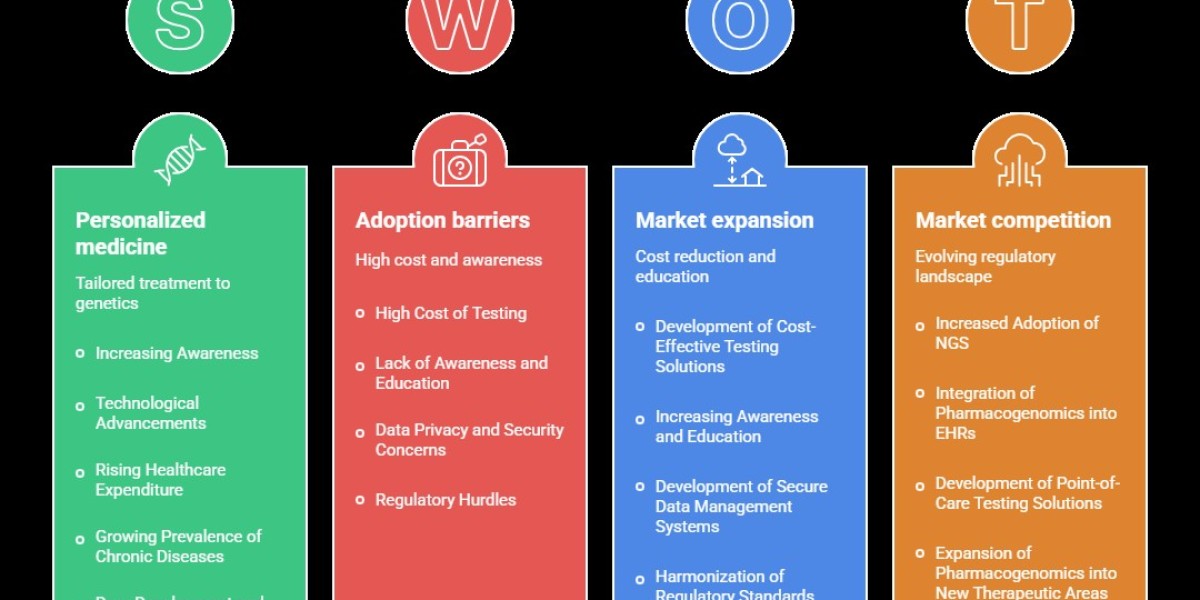
- Increasing Awareness of Personalized Medicine: Healthcare providers and patients are increasingly recognizing the benefits of personalized medicine, which tailors treatment to an individual's unique genetic profile. This awareness is driving demand for pharmacogenomic testing.
- Technological Advancements in Genetic Testing: Advances in genetic sequencing technologies, such as next-generation sequencing (NGS), have made genetic testing more affordable, accessible, and efficient. This has facilitated the widespread adoption of pharmacogenomic testing.
- Rising Healthcare Expenditure: Growing healthcare expenditure, particularly in developed countries, is supporting the adoption of advanced diagnostic and treatment approaches, including pharmacogenomics.
- Growing Prevalence of Chronic Diseases: The increasing prevalence of chronic diseases, such as cancer, cardiovascular disease, and neurological disorders, is driving demand for personalized treatment strategies, including pharmacogenomics.
- Drug Development and Clinical Trials: Pharmacogenomics is playing an increasingly important role in drug development and clinical trials. By identifying genetic markers that predict drug response, pharmaceutical companies can improve the efficiency and success rate of drug development.
- Government Support and Initiatives: Governments and regulatory agencies are increasingly supporting the adoption of pharmacogenomics through funding for research, development of guidelines, and reimbursement policies.
Market Segmentation
The pharmacogenomics market can be segmented based on various factors, including:
- Technology:
- Polymerase Chain Reaction (PCR)
- Next-Generation Sequencing (NGS)
- Microarrays
- Other Technologies
- Application:
- Oncology
- Cardiology
- Neurology
- Pain Management
- Psychiatry
- Other Applications
- End User:
- Hospitals and Clinics
- Diagnostic Laboratories
- Pharmaceutical Companies
- Research Institutes
Regional Analysis
The pharmacogenomics market is geographically segmented into North America, Europe, Asia Pacific, Latin America, and the Middle East and Africa. North America currently dominates the market, driven by the presence of major pharmaceutical companies, advanced healthcare infrastructure, and favorable reimbursement policies. However, the Asia Pacific region is expected to witness the highest growth rate during the forecast period, driven by increasing healthcare expenditure, rising awareness of personalized medicine, and growing adoption of genetic testing.
Competitive Landscape
The global pharmacogenomics market is characterized by the presence of several key players, including:
- Thermo Fisher Scientific Inc.
- Illumina, Inc.
- Agilent Technologies, Inc.
- F. Hoffmann-La Roche Ltd.
- QIAGEN N.V.
- Myriad Genetics, Inc.
- Laboratory Corporation of America Holdings
- Quest Diagnostics Incorporated
- Assurex Health, Inc. (Myriad Mental Health)
- GenScript Biotech Corporation
These companies are focused on developing and commercializing innovative pharmacogenomic products and services, as well as expanding their geographic presence through strategic collaborations and acquisitions.
Challenges and Opportunities
While the pharmacogenomics market offers significant growth opportunities, it also faces certain challenges:
- High Cost of Testing: The cost of pharmacogenomic testing can be a barrier to adoption, particularly in developing countries.
- Lack of Awareness and Education: Many healthcare providers and patients are still unaware of the benefits of pharmacogenomics.
- Data Privacy and Security Concerns: The use of genetic information raises concerns about data privacy and security.
- Regulatory Hurdles: The regulatory landscape for pharmacogenomics is still evolving, which can create uncertainty for companies operating in the market.
Despite these challenges, the pharmacogenomics market offers significant opportunities for growth:
- Development of Cost-Effective Testing Solutions: Reducing the cost of pharmacogenomic testing can make it more accessible to a wider range of patients.
- Increasing Awareness and Education: Educating healthcare providers and patients about the benefits of pharmacogenomics can drive adoption.
- Development of Secure Data Management Systems: Implementing robust data privacy and security measures can address concerns about the use of genetic information.
- Harmonization of Regulatory Standards: Harmonizing regulatory standards for pharmacogenomics can create a more predictable and favorable environment for companies operating in the market.
Future Trends
The pharmacogenomics market is expected to witness several key trends in the coming years:
- Increased Adoption of NGS: Next-generation sequencing is expected to become the dominant technology for pharmacogenomic testing, driven by its ability to analyze multiple genes simultaneously and its decreasing cost.
- Integration of Pharmacogenomics into Electronic Health Records (EHRs): Integrating pharmacogenomic data into EHRs can facilitate the use of this information in clinical decision-making.
- Development of Point-of-Care Testing Solutions: Point-of-care pharmacogenomic testing can provide rapid results, enabling healthcare providers to make more informed treatment decisions at the point of care.
- Expansion of Pharmacogenomics into New Therapeutic Areas: Pharmacogenomics is expected to expand into new therapeutic areas, such as autoimmune diseases and infectious diseases.
- Increased Use of Artificial Intelligence (AI) and Machine Learning (ML): AI and ML can be used to analyze large datasets of pharmacogenomic data, identify new genetic markers, and predict drug response with greater accuracy.
Conclusion
The global pharmacogenomics market is poised for strong growth in the coming years, driven by increasing awareness of personalized medicine, technological advancements in genetic testing, and rising healthcare expenditure. While the market faces certain challenges, such as the high cost of testing and lack of awareness, the opportunities for growth are significant. By addressing these challenges and capitalizing on emerging trends, companies operating in the pharmacogenomics market can achieve significant success. The projected CAGR of 10.6% from 2023 to 2028, culminating in a forecasted valuation of US$5.8 billion by the end of the period, underscores the immense potential of this rapidly evolving field.