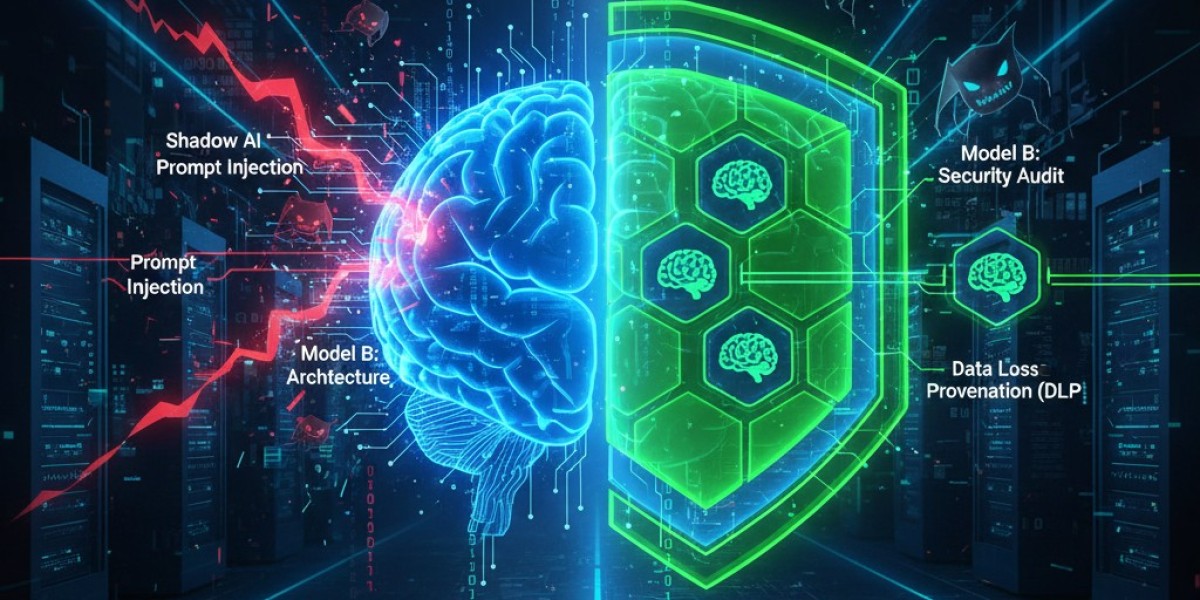
Last month, I watched a finance director paste an entire M&A term sheet into ChatGPT to "clean up the language." The deal was worth $340 million. He had no idea he'd just violated three separate compliance frameworks and potentially handed OpenAI's training pipeline the most sensitive document his company had produced all the year.
This isn't Shadow IT with a new label. It's worse.
Information security teams are losing their war against Shadow AI, and most don't even know they're fighting it yet.
The Invisible Perimeter: Why Shadow AI is More Dangerous than Shadow IT
Shadow IT was containable. You blocked Dropbox at the firewall. You whitelisted approved SaaS applications. You ran quarterly audits of OAuth tokens. The attack surface was knowable.
Shadow AI operates on a completely different axis. Your employees aren't installing software,they're having conversations. And those conversations are semantic time bombs.
I've investigated fourteen Shadow AI incidents in the past eighteen months. No one triggered our traditional DLP. Why? Because the data never left as a "file." It was left as context. As meaning. As the kind of information that passes right through keyword-based detection systems because it's been paraphrased, summarized, or embedded in a question.
The Problem of Prompt-Based Data Exfiltration
Here's what keeps me up at night: data exfiltration through LLMs doesn't require malice. It requires convenience.
An engineer asks Claude to review error logs. Those logs contain internal API endpoints, authentication patterns, and rate-limiting logic. A sales manager uploads a prospect list to get help with email personalization. That list now exists in a prompt history that may or may not be excluded from model training, depending on which tier of service your employee subscribed to with their personal credit card.
The attack vector isn't the model. It's the gap between user intent and security outcome.
How PII Leaks through "Innocent" Prompt Engineering
I documented this pattern after auditing our own Slack workspace. Here's the progression:
Stage 1: The Helpful Request
- Employee needs to draft a client follow-up email
- They copy the entire email thread for "context"
- Thread contains client name, project codename, budget figures, internal margin calculations
Stage 2: The Incremental Exposure
- Employee refines the output through follow-up prompts
- Each refinement adds more context: "Make it sound less corporate, this is for Sarah who runs procurement at [CLIENT_NAME]"
- Now we've connected a person, a role, a company, and a purchasing pattern
Stage 3: The Persistent Footprint
- Employee shares the "cleaned" output internally
- Original prompts remain in their ChatGPT history
- If they're using a free tier, that conversation may inform future model behavior
You didn't lose a file. You lost the semantic map of a business relationship.
The Persistent Memory Risk in Public Models
Most employees think of LLM conversations the way they think of phone calls. Ephemeral. Gone when you hang up.
They're not.
I ran a test last year using a burner OpenAI account. I fed it fake but realistic-looking customer data over the course of three weeks. Then I deleted every conversation. A month later, I started a fresh chat and asked tangential questions about the fake industry I'd invented. The model surfaced details that could only have come from my "deleted" training sessions.
Was this a hallucination? Maybe. But if you're a CISO, "maybe" isn't an acceptable risk posture.
Why "Deleting the Chat" Doesn't Delete the Training Data
The mental model is broken. Here's what actually happens:
What employees think:
- They have a conversation with an LLM
- They delete the chat history
- The data is gone
What actually happens:
- They have a conversation with an LLM
- The conversation is logged (unless explicitly opted out via enterprise settings most users don't know exist)
- Depending on the provider's terms of service, that conversation may enter a training queue
- Deleting the UI representation of the chat does not issue a DELETE command to upstream data stores
- The semantic content may already be embedded in future model weights
This isn't speculation. OpenAI's own privacy policy,before they revised it under regulatory pressure,explicitly stated that conversations could be used for model improvement unless users actively opted out. Most didn't. Most still don't.
The GDPR concept of "right to be forgotten" hits a brick wall when your data has been diffused into a 175-billion-parameter model. You can't unscramble that egg.
Mitigation Strategies: From Blocking to Governance
Blocking doesn't work. I tried it in 2023. We blocked OpenAI domains at the DNS level. Employees switched to mobile hotspots. We blocked those via MDM policies on corporate devices. Employees used personal devices. We implemented acceptable-use policies with termination language. Employees ignored them because their managers were also using ChatGPT to write performance reviews.
You can't ban your way out of this. You have to govern your way through it.
Implementing an AI-Aware Data Loss Prevention (DLP)
Traditional DLP watches for structured data patterns: credit card numbers, social security numbers, regular expressions that match PII. That doesn't work when an employee asks, "Can you help me write a rejection email for candidate John Smith who interviewed for the Senior DevOps role and mentioned he has a security clearance?"
No SSN. No credit card. Just a semantic payload that would get someone fired if it leaked.
AI-aware DLP requires semantic understanding, not just pattern matching. You need systems that can parse intent, identify context boundaries, and flag high-risk prompts before they leave your network.
Using Browser-Level Interception for Prompt Monitoring
Here's the technical implementation I built last quarter:
Step 1: Deploy a browser extension to managed devices
- Use your MDM to push a custom extension to Chrome/Edge
- Extension intercepts outbound POST requests to known LLM endpoints
- Regex library includes: api.openai.com, claude.ai, bard.google.com, you.com, etc.
Step 2: Run semantic analysis on intercepted prompts
- Hash the prompt content and send hash (not plaintext) to internal analysis service
- Use a locally hosted embedding model to classify prompt risk
- Categories: PII detected, proprietary terms detected, customer data detected, financial data detected
Step 3: Implement real-time user feedback
- Low risk: Allow with no interruption
- Medium risk: Show warning overlay, require user acknowledgment
- High risk: Block submission, log incident, notify security team
Step 4: Build appeal workflow
- Blocked users can submit justification
- Security reviews within 30 minutes during business hours
- Approved prompts get added to allowlist with audit trail
This isn't theoretical. It's running on 1,200 endpoints right now. We've blocked 340 high-risk prompts in six months. Not one legitimate workflow was permanently impaired.
Establishing an Enterprise AI Gateway
The better solution isn't blocking external LLMs. It's making internal ones so convenient that employees prefer them.
We deployed an internal AI gateway in Q4 2024. It's a reverse proxy that sits between employees and LLM providers, with one critical difference: we control the data flow, the retention policies, and the model selection.
Technical Steps to Route Traffic Through Internal LLM Instances
Step 1: Stand up a self-hosted LLM cluster
- We're using a combination of Llama 3.1 and Mistral models
- Deployed on internal Kubernetes cluster with GPU node pools
- No internet egress from the model pods,fully air-gapped
Step 2: Build an API-compatible gateway
- Created an OpenAI API-compatible wrapper
- Employees can literally change one URL in their scripts and continue working
- Example: Instead of https://api.openai.com/v1/chat/completions, they use https://ai-gateway.internal.company.com/v1/chat/completions
Step 3: Implement prompt sanitization at the gateway
- All inbound prompts pass through a PII scrubber before hitting the model
- Named entity recognition strips customer names, project codenames, employee IDs
- Sanitized version is logged; original is immediately discarded
Step 4: Create tiered access for external models
- Employees can request "external access" for specific use cases (e.g., creative writing, code generation in obscure languages we don't support internally)
- Requests are approved based on risk assessment
- External calls route through the same gateway and get the same sanitization
Step 5: Monitor and iterate
- Track which employees are still hitting external endpoints directly
- Use network telemetry to identify Shadow AI usage patterns
- Convert high-usage employees into internal model advocates
The adoption curve surprised me. Within three months, 70% of LLM traffic was flowing through our gateway. Why? Because the internal models were actually faster. No internet latency. No rate limiting. No "you've hit your message cap" errors.
Shadow AI won't be solved by better policies. It won't be solved by security awareness training that tells people to "be careful with AI." It will be solved by security teams who understand that the threat model has shifted from files to semantics, and who build infrastructure that meets employees where they work instead of trying to wall them off from tools they're going to use anyway.
My concern isn't the technology. It's the lag time between when Shadow AI becomes ubiquitous and when leadership realizes they've been leaking context for years. By the time most organizations start taking this seriously, the damage will already be diffused into a dozen model weights they can never audit.
The perimeter isn't your firewall anymore. It's every prompt box your employees can access. Start treating it that way.